Why one article earned The Boston Globe thousands of subscribers


How strong journalism, smart distribution, and a low-threshold paywall converged in an exceptional success story. And why declining visibility in Google Discover raises questions about sustainable audience growth.
A single journalistic article that generates approximately 1,000 new subscribers within 24 hours and several thousand after three days. Add to that a post on X with over 31 million views, and you have an exceptional success story. It is not uncommon for an article to go viral and reach millions. It is also common for articles to generate new subscribers. But rarely do you see a single article achieve both on this scale.
Following an article on Nieman Lab, I decided to investigate how The Boston Globe achieved this with a magazine story by Annalisa Quinn about a lesbian bar in Greenfield, Massachusetts. I delved into the journalistic approach, technical SEO, distribution strategy, and paywall. What struck me most was how various components converged: strong, neutral journalism, a solid technical foundation, and an editorial team that continued to enrich the story as interest grew. It demonstrates that while you cannot plan a viral story, a publisher can prepare to maximize the impact of such a moment.
During my research, however, I discovered something else striking. While The Boston Globe was bringing in thousands of new subscribers, the publisher was virtually invisible in our Google Discover monitoring data. Measured visibility had even declined sharply in recent months. This raised an interesting question: can a strategy that yields thousands of subscriptions in the short term simultaneously come at the expense of reaching new readers? In this analysis, I examine not only how The Boston Globe achieved this exceptional result but also what other publishers can learn about the balance between conversion and sustainable audience growth.
TLDR; key findings.
Methodology: analysis based on Nieman Lab, Mediaweek, Newsweek, Fox News, and Stuff, X posts from the Globe, Annalisa Quinn, and Max Tani, Marfeel Monitoring and live investigation of the article.
1. Result
According to a spokesperson for The Boston Globe, quoted by Nieman Lab on September 25, the article generated approximately 1,000 new subscriptions within 24 hours. After about 72 hours, that number reached several thousand. The Globe did not release an exact figure, but it is clear that the article performed exceptionally well. It is important to note that these subscription figures come from The Boston Globe itself and have not been independently verified.
The success was also quickly noted internally. Media journalist Max Tani shared an internal memo to the editorial staff on September 23, in which the managing editor described the article as “by far our best performing story of the year.” According to the same memo, the story was on track to break several Globe records. Notably, the editorial team had insight into the article’s performance just one day after publication. This illustrates how vital it is for publishers to track not only reach but also subscription conversions at the article level.
What makes the success particularly interesting is that the interest was not limited to a single viral peak. Google Trends shows that search interest for ‘lesbian bar last ditch’ declined gradually after the initial peak, rather than immediately falling back to virtually zero.
By comparison: with many short-lived news events, such as a football match, you typically see a sharp peak around the event, after which search interest rapidly declines. The Last Ditch story, however, continued to draw interest for several days.
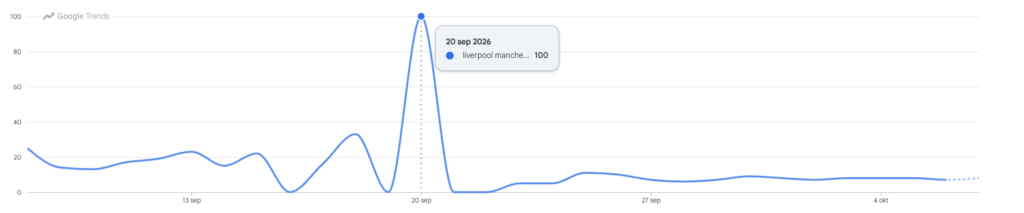
This sustained interest coincided with new publications from The Boston Globe, social media reactions, and coverage from other national and international news organizations. The extent to which individual events influenced the course of search interest cannot be determined. However, the trend shows that the story remained relevant longer than just on the day of publication. For a subscription publisher, this is significant: every new wave of interest offers fresh opportunities to reach readers and potentially convert them into paying subscribers.
But before we look at how The Boston Globe capitalized on that success, it is important to understand why this particular story resonated so deeply. Because behind the millions of views and thousands of new subscriptions was, first and foremost, a strong journalistic narrative.
2. Journalism
Over the past five years, I have increasingly come to believe in the power of good journalism and the way journalism and SEO can reinforce each other. Through my collaboration with various editorial teams, I have seen that the greatest opportunities often arise when journalistic quality and knowledge of reaching readers converge. This does not mean every article should be written from an SEO perspective. On the contrary. Annalisa Quinn’s story for The Boston Globe is, in my view, a fine example of how strong journalism can form the basis for exceptional reach and, ultimately, commercial results.
First, some context. Last Ditch is a lesbian bar in Greenfield, Massachusetts, that caters to people vulnerable to COVID-19. Visitors were required to wear a KN95 mask, but to remain financially viable, the owner decided to lift the mask mandate on Saturday nights. What seems like a relatively minor policy change at first glance triggered a storm of criticism online. For some visitors, it felt like the abandonment of a safe environment, while others felt the measure had gone much too far.
The interesting thing about this story is that a local conflict quickly touches on much larger societal issues. It is not just about a bar and masks, but also about inclusivity, health, individual freedom, and the financial reality of a small business owner. This makes the subject relatable to a much larger group of people than just the residents of Greenfield. Virtually everyone can form an opinion on the situation based on their own beliefs.
What Annalisa Quinn then does exceptionally well is let the events speak for themselves. She does not explicitly take sides or try to tell the reader who is right. Instead, she describes the conflict from various perspectives. Nieman Lab calls it “a perfect piece,” written “in such a neutral register.” It is precisely this neutral approach that makes the story so strong, in my opinion. Proponents and opponents can read the same article and each find their own arguments reflected in it. It is my interpretation that this contributed to the story’s massive spread. In the comments under The Boston Globe’s X post, both perspectives are certainly evident.
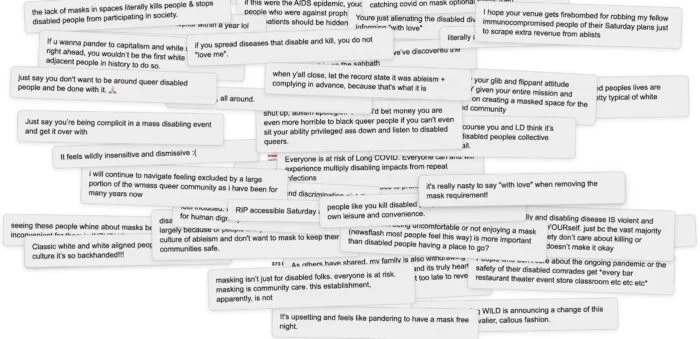
The way the article is structured also contributes to this. Even before the reader reaches the first paragraph, they are confronted with a collection of Instagram comments about the bar. The heated discussion is thus immediately visible and serves as the opening of the story. As a journalist, you don’t need to explain that the subject is sensitive; the reactions show it themselves. This creates curiosity about exactly what happened and why people think so differently about the situation.
Another interesting aspect is that the discussion took place not only on external platforms but also on The Boston Globe’s own website. On October 7, there were 654 comments under the article. For a publisher, this is valuable: readers are not just consuming the journalism but are also engaging with each other on the publisher’s own platform. When a subscription is required to participate in that discussion, it can provide an additional reason to subscribe. While it is unknown how many subscriptions this actually generated, it demonstrates how journalistic engagement and commercial objectives can reinforce each other.
What I primarily take from this story is that good journalism is not always about taking a pronounced stand. By taking different perspectives seriously and letting the facts speak for themselves, Quinn created space for a discussion that reached far beyond the original local subject. Journalistic quality thus formed the basis for success. But to bring that quality to the attention of millions, a story must be well-packaged. And that is exactly where you see how journalism and SEO can reinforce each other.
3. Packaging
A strong journalistic story forms the foundation, but the way you present that story partly determines whether people decide to read it. An article can be excellent in terms of content, but if the title is not appealing or the image does not stand out sufficiently, you risk potential readers simply passing it by. This is precisely why I find the way The Boston Globe packaged this story so interesting. The editorial team did not choose a single title and description for all channels but used different variants tailored to how readers discover a story.
During my technical analysis of the article, I found four different elements in the source code that play a role here: the title tag, the H1 and og:title, the meta description, and the og:description. Notably, the factual title and the narrative title differ clearly, while both represent the same journalistic content.
- Title tag and headline in the structured data: Greenfield lesbian bar Last Ditch faces mask-rule backlash
- H1 and og:title: A Western Mass. lesbian bar required KN-95 masks. When it changed the rules, all hell broke loose.
- Meta description: Last Ditch, a lesbian bar in Greenfield, eased its KN-95 mask rule in hopes of staying afloat. The decision unleashed a fierce online backlash.
- og:description: Last Ditch Bar in Greenfield wanted to build community. They got a firestorm instead.
The title tag is factual and descriptive. With Greenfield, lesbian bar, Last Ditch, and mask-rule backlash, the key entities and the conflict are directly identified. This aligns well with people actively searching for information about this event. The H1 and og:title, on the other hand, opt for a narrative approach. The reader is first given the context of a bar where masks were mandatory, followed by an unexpected turn: “When it changed the rules, all hell broke loose.” This phrasing piques curiosity about exactly what happened and why a relatively small change caused so much commotion.
In my view, this shows how journalism and SEO can reinforce each other. A factual title helps clarify the subject immediately, while a narrative title plays on the curiosity of potential readers. Both have their own value, depending on the context in which someone encounters the article. It is important to emphasize that Google ultimately determines which title is shown in Search, Top Stories, and Discover. Being able to set the different title fields separately primarily offers publishers the opportunity to present their story in multiple ways. Which variant is actually used is not entirely in their hands.
At least as important as the title is the photography. For the article, Sophie Park produced an original photo report with images of the bar, the owner, a karaoke night, and the surrounding area. The Boston Globe’s X post used a photo showing two people at the bar, one of whom is wearing a mask. This makes the central conflict immediately visible. The image not only draws attention but also adds journalistic context. Combined with the narrative title, it creates a strong presentation that invites further reading.
What I find particularly strong here is that the title and the image do not create expectations that the article then fails to meet. The narrative title promises a conflict, the photo makes that conflict tangible, and the article then provides journalistic depth. This is an important distinction. A provocative title can generate visitors, but if the content does not live up to expectations, the chance of building a sustainable relationship with readers is small. Ultimately, journalistic quality must be able to deliver on the curiosity piqued by the presentation.
There is a practical lesson here for editorial teams. Ensure your CMS allows you to fill in and, where necessary, optimize the title tag, H1, and og:title separately. This does not mean every article needs three completely different titles, but it does mean editorial teams should have the freedom to tailor a story to the various ways readers discover it. The same applies to photography: invest where possible in original visual material that is not only attractive but also actually tells something about the subject.
With the journalistic content, titles, and photography, The Boston Globe had created a strong starting position. But even an excellent story with an attractive presentation does not go viral on its own. For that, it must also come to the attention of the right people. And once the story gained traction, the Globe demonstrated how to further capitalize on that momentum.

4. Strategy
A strong journalistic story, an attractive title, and good photography are important prerequisites for success. But they offer no guarantee that an article will actually go viral. What makes this case particularly interesting to me is how The Boston Globe responded to the attention the story received. The editorial team did not just publish an article that reached millions; they also continued to actively monitor and enrich the subject in the following days. This created constant new reasons to draw readers to the Globe’s journalism.
Reconstructing the events, I see three key moments where the Globe was well-positioned to benefit from the success: preparation before publication, distribution in the initial hours, and how the editorial team subsequently capitalized on the momentum.
A strong foundation for publication
The original article appeared on September 22, 2026, at 5:30 AM local time in Boston. As we saw in the previous chapters, the journalistic package was comprehensive: an in-depth magazine story, original photography, various title variants, and a technically well-configured article page. Furthermore, the story was behind a paywall with a low-threshold introductory offer. The Globe had thus paid attention not only to content and presentation but also to the possibility of converting interested readers into paying subscribers.
I find this an important starting point. Many publishers focus primarily on journalistic content and the moment of publication when preparing an article. But when a story receives unexpectedly high attention, you don’t want to be thinking about the right image, social media presentation, or subscription offer after the fact. Opportunities lie precisely in magazine stories, where more preparation time is typically available than with breaking news. Whether the Globe anticipated potential viral spread beforehand, I cannot determine. What I do see is that several key components were already in place when the story appeared online.
The first hours: initiating distribution
Approximately four and a half hours after publication, at 10:02 AM, The Boston Globe shared the article via its own X account. The editorial team used Sophie Park’s strong photo and wrote an introduction centered on the conflict. At 11:37 AM, Annalisa Quinn followed with a post on her personal account. Thus, the story was distributed not only through the publisher’s official channel but also through the journalist who wrote it.
The latter is sometimes underestimated, in my opinion. Journalists have their own networks, expertise, and credibility. By giving them an active role in distributing their work, publishers can reach different audiences than through their brand accounts alone. Exactly how many extra visitors or subscriptions Quinn’s post generated, I cannot determine. It is clear, however, that both posts received significant attention and that the Globe’s own X post eventually became a major part of the viral spread. I will return to this in more detail in Chapter 5.
What I find particularly interesting here is that the Globe actively brought the story to people’s attention early on. The editorial team did not wait solely for traffic from Google or other news organizations but used its own distribution channels to highlight the subject. Whether the posts were scheduled in advance or part of a specific distribution strategy, I do not know. However, this approach shows how important it is for publishers to consider initial distribution when publishing a major journalistic story.
The following days: capitalizing on momentum
The most interesting developments perhaps occurred after it became clear that the article was performing exceptionally well. On September 23, just one day after publication, media journalist Max Tani shared an internal memo in which The Boston Globe’s managing editor described the article as “by far our best performing story of the year.” According to the same memo, the story was on track to break several records. This shows that results were quickly known within the editorial office and that the Globe had insight into the article’s commercial performance.
In the following days, the editorial team continued to pay attention to the subject. On September 24, the original article was updated, as evidenced by the dateModified in the structured data. Exactly what was changed in the text, I have not been able to determine. However, a video by Von Smith explaining the controversy surrounding the bar appeared that same day. This video was not only published separately but also included in the original article. This gave the main article an additional journalistic element and simultaneously created a new entry point to the subject.
A day later, on September 25, communications director Adam Bagni publicly responded to criticism from the local Communist Party. Thus, the Globe itself joined the broader discussion about the reporting. On September 28, a new report followed about a karaoke night at the bar. This follow-up story offered readers a new perspective and, like the video, referred back to the original paid article.
Ultimately, this case shows how journalistic quality, distribution, and engagement can reinforce each other. The story reached millions, evoked diverse reactions, and brought part of that discussion to The Boston Globe’s website. But engagement alone does not yield subscriptions. For that, a publisher must know how to convert interest into an attractive offer at the right moment. And that is exactly where The Boston Globe’s paywall played a key role.
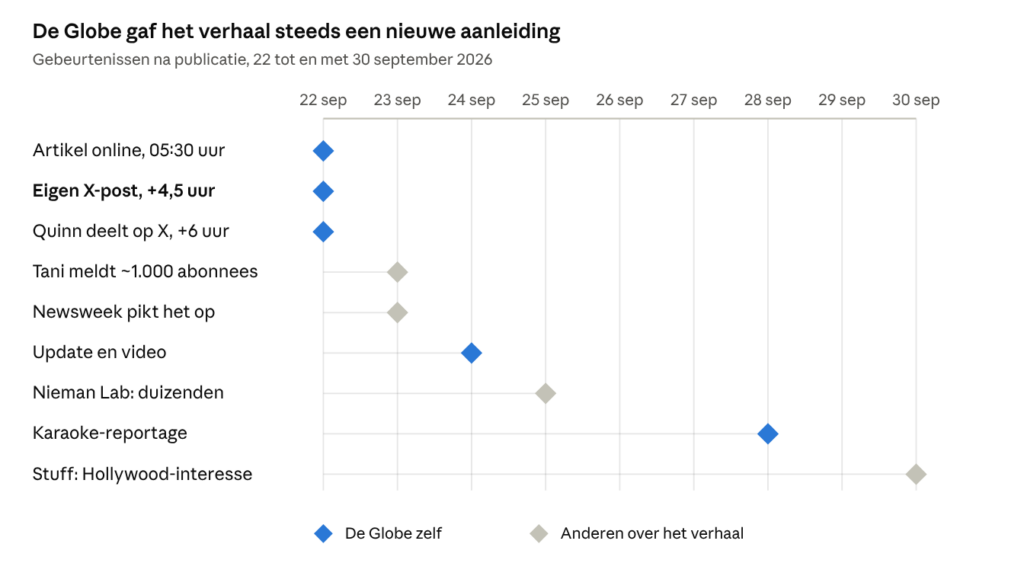
The timeline shows that the story was not limited to a single publication moment. Relevant developments occurred on six out of nine days, either from the Globe itself or from other parties picking up the subject. This does not automatically mean all follow-up steps were planned in advance or that they were directly responsible for the thousands of new subscriptions. However, the sequence of events shows how interest was sustained over several days by new publications and developments.
For publishers, there is an important lesson here. Ensure your editorial team is not only prepared for the publication of a major story but also thinks about what should happen when an article receives unexpectedly high attention. Who monitors performance? When do you decide to update an article? Who investigates whether an interesting follow-up publication or video is possible? And how do you ensure those new publications contribute to the further distribution of the original story?
A playbook for these situations doesn’t have to be complicated, but it helps in reacting faster when opportunities arise. It is crucial that journalistic considerations remain leading. Not every viral story automatically deserves a follow-up, but when there is new information or relevant perspectives, an editorial team can create both journalistic and commercial value.
What The Boston Globe ultimately did so well was not just publishing a strong story, but also continuing to invest in the subject while interest persisted. To what extent this was planned in advance or resulted from quick action remains unclear. The result, in any case, was that the original article could be brought back to people’s attention over several days.
And that brings us to the next question: how did the story then spread outside The Boston Globe’s own channels, and what role did other media and social media users play in reaching millions of people?
5. Distribution
The Boston Globe’s own X post proved to be a major driver of distribution. According to Mediaweek, the story quickly gained significant attention after the Globe shared it on X. Within 24 hours, according to figures from Know Your Meme, the post already had approximately 17.6 million views. By October 7, that number had risen to a staggering 31.4 million. For a local magazine story about a bar in Massachusetts, that is an exceptional reach.
What I find particularly interesting is that the success was not limited to the Globe’s official account. Journalist Annalisa Quinn and media journalist Max Tani also reached millions with their posts. Tani’s post stood out especially, in which he shared an internal memo about the article’s commercial success. That post eventually received even more likes and reposts than The Boston Globe’s original post.
- @BostonGlobe on Sep 22, 10:02 AM (+4.5 hours) with 31.4M views, 2,100 comments, 972 reposts, 20k+ likes.
- @Annalisa_Qui on Sep 22, 11:37 AM (+6 hours) with 1.8M views, 200+ comments, 200 reposts, 6k+ likes
- @maxwelltani (quote of the Globe post, about the memo) on Sep 23, 12:32 PM (+31 hours), 5.7M views, 300+ comments, 1,600+ reposts, and 35k+ likes
The figures are snapshots from October 7, 2026. Views of X posts are not the same as visits to the article or the number of unique individuals who read the story.
The latter is perhaps one of the most interesting observations from this case. The journalistic story went viral, but then the success of that story became news itself. The internal memo Tani shared created a new reason for people to talk about the Globe and the original article. This generated a second stream of attention, this time not just because of the controversy surrounding the bar, but because of the publisher’s exceptional commercial performance.
Simultaneously, the subject was picked up by other national and international news organizations. Newsweek published on the uproar on September 23, reporting that Senator Ted Cruz, among others, joined the discussion. Fox News also covered the issue. Subsequently, the story spread further to international titles, including Mediaweek in Australia. On September 30, New Zealand’s Stuff even reported that there might be Hollywood interest in a possible film or series about the events.
The original local story thus grew into a subject discussed worldwide. The various publications provided new moments for readers to encounter the controversy. In these instances, The Boston Globe was frequently cited as the original source. This is valuable from an audience growth perspective: not only because the brand gains exposure to new audiences, but also because interested readers can find their way to the original journalism.
Exactly how many visitors actually reached The Boston Globe via these external publications, I cannot determine. For that, I would need access to the publisher’s internal analytics. We also do not know what proportion of new subscriptions came from X, other news organizations, or direct visits. However, the distribution shows how a single journalistic story can be repeatedly brought to attention through various channels.
For publishers, there is an important lesson here. Distribution does not stop with posting an article on your own website or sharing it via the official social media account. Journalists can contribute to distribution with their personal networks, while other media and public figures can then bring a story to the attention of completely new audiences. As a publisher, you don’t have full control over who picks up a story, but you can ensure the original article is recognizable as the source and that interested visitors can easily find their way to your website.
Furthermore, this case shows that reach does not always come from a single channel. The Globe’s own X post gave the story a massive boost, but attention then spread via journalists, public figures, and other news organizations. This created a combination of owned distribution and external attention that carried the story far beyond The Boston Globe’s original target audience.
But millions of views do not automatically mean people read an article, let alone that they are willing to pay for it. For that, a story must evoke sufficient interest and engagement. And it is precisely in that area that this case is particularly interesting.
6. Engagement
Millions of views on social media are impressive but do not tell the whole story. A post can be seen by millions without them actually clicking through or being interested in the content. What makes the Last Ditch story special is that it not only reached many people but also triggered a massive discussion. On October 7, there were over 2,100 comments under The Boston Globe’s original X post and 654 comments under the article itself. These are clear indications that the subject generated more than just fleeting attention.
Why did this particular story evoke so many reactions? In my view, the explanation lies largely in the journalistic choices discussed in Chapter 2. The conflict surrounding Last Ditch touches on topics about which people have strongly divergent views: inclusivity, health, individual freedom, and the financial position of small business owners. At the same time, Annalisa Quinn chose a neutral journalistic approach, without explicitly telling the reader who was right. This created space for different interpretations and allowed the story to be shared from multiple perspectives. These varying viewpoints are clearly reflected in the comments under the X post.
The presentation of the article also likely contributed to that engagement. Sophie Park’s photo made the conflict immediately visible, while the narrative title piqued curiosity about exactly what had happened. Together, they formed a strong incentive to open the article, respond to it, or share it with others. It is important to distinguish between what we can determine and what we suspect. We know the posts evoked high interaction, but we cannot prove how much of that was directly caused by the title, photography, or journalistic tone.
From an audience growth perspective, what I find perhaps even more interesting is that the discussion did not take place exclusively on external platforms. An extensive conversation also emerged under the original article on The Boston Globe’s website. This is valuable for a publisher because readers are not just consuming the journalism but are actively participating in a discussion within the publisher’s own environment. While social media platforms largely determine how and to whom a post is distributed, a publisher has more control over the user experience and the opportunities to build a relationship with readers on their own website.
There is also a commercial aspect to this case. As far as I could determine during my research, visitors had to take out a subscription to participate in the discussion under the article. Thus, not only reading the full story but also the ability to comment became part of the paid offering. For someone with a strong opinion on the subject who wants to join the conversation, this can be an additional reason to subscribe. Whether this actually made a significant contribution to the thousands of new subscriptions, I cannot determine without internal conversion data.
What publishers can learn from this is that engagement can mean more than just reach or a high number of page views. When a journalistic story prompts discussion, opportunities arise to keep readers engaged with the subject and the news brand for longer. This, however, requires more than simply opening up a comment section. A well-functioning discussion environment, clear moderation, and an editorial team that remains involved in the subject are at least as important for making that interaction valuable.
For editorial teams, it is therefore interesting to monitor engagement from the first hours after publication. Not because a high number of comments automatically means a story will spread further, but because it provides insight into interest in a subject. Comments, shared posts, reading time, and return visits can help determine if there is a need for additional journalism. Thus, engagement is not only a result of successful distribution but also valuable input for editorial decisions.
Ultimately, this case demonstrates how journalistic quality, distribution, and engagement can reinforce one another. The story reached millions of people, sparked diverse reactions, and brought a portion of that discussion to The Boston Globe’s website. However, engagement alone does not yield subscriptions. To achieve that, a publisher must know how to convert interest into an attractive offer at the right moment. And it was precisely there that The Boston Globe’s paywall played a vital role.
7. Conversion
A journalistic story that reaches millions and triggers much discussion is, of course, fantastic for a publisher. But for a publisher largely dependent on subscriptions, it only becomes truly interesting when a portion of that interest is converted into paying readers. As we saw in the first chapter, The Boston Globe succeeded exceptionally well in this. Within days, the Last Ditch story generated thousands of new subscriptions. During my research, I was particularly struck by how low the publisher had set the financial barrier to access the article.
Anyone opening the article without a subscription was confronted with a hard paywall. The full journalistic content was not freely accessible, and visitors were shown a clear subscription offer. Around the publication on September 22, according to Nieman Lab, an introductory offer of $1 for the first six months applied, after which the price would rise to approximately $30 per month. During my own research on October 5 and 7, I saw a slightly different offer: “$1 for the rest of the year.” The exact offer thus changed during the period when the story received high attention.

What makes this approach interesting is the combination of a hard paywall and an exceptionally low introductory price. Visitors arriving at the article via X might have already read a lot about the subject. They had seen the photo, followed the discussion, and wanted to know exactly what happened. At such a moment, a $1 offer can be attractive. The financial barrier is small, while curiosity about the full story can be high. This does not mean, however, that we know how many visitors subscribed thanks to this specific offer. Without internal conversion data, I cannot determine what proportion of the success is attributable to the price, the paywall, or the immense interest in the article.
The payment process was also designed to cause as little friction as possible. Visitors could pay with Apple Pay or a creditcard, among other methods. Additionally, it was mentioned directly under the subscription button that the subscription could be canceled at any time. These are small but important parts of the user experience. Especially when someone clicks on an article out of curiosity and did not previously intend to subscribe, you want to prevent a complicated registration or payment process from becoming an obstacle.
Another interesting detail is that The Boston Globe was not exclusively selling access to this one story. The paywall explicitly communicated the broader value of the subscription with the message “Unlock news, sports, games, and more.” Thus, interest in one article was used to introduce visitors to the publisher’s full range of offerings. This is an important distinction from an audience growth perspective. As a publisher, you ultimately don’t want someone to pay only to read one article, but for them to discover enough value to remain a subscriber after the introductory period.
During my research, it was also noticeable that different subscription offers were visible simultaneously. While the overlay on October 7 communicated the $1 offer for the rest of the year, the underlying page still displayed the text “Get 6 Months of Unlimited Access for $1.” Whether this was part of an experiment, a difference between campaigns, or an outdated offer, I could not determine. However, as a publisher, I would want to prevent visitors from seeing different terms during the subscription process. Clarity is vital, especially in a payment process.
The Globe had also built in another way to connect interested visitors to the brand. Below the paywall was a sign-up field for the free Globe Magazine newsletter. Thus, the publisher offered even visitors who did not yet want to take out a paid subscription a way to stay in touch with its journalism. I find this interesting from an audience growth perspective because not every new visitor is immediately willing to pay. A newsletter can then be a first step toward a long-term relationship with the news brand.
Altogether, this case shows how important it is for a publisher to be prepared for the moment a story receives exceptional interest. The Boston Globe had not only a strong journalistic story and effective distribution but also a subscription offer that allowed interested visitors to join with a relatively low threshold. The combination proved commercially very successful, although without internal data, we cannot determine which individual components contributed most to the thousands of new subscriptions.
Yet the chosen approach also raises an interesting question. A hard paywall can work well when a visitor is already strongly interested in a story and willing to pay for it. But does that also apply to someone who doesn’t know the news brand yet and clicks on an article for the first time out of curiosity? During my research, I discovered something striking: while The Boston Globe was bringing in thousands of new subscribers, the publisher was virtually invisible in our Google Discover data. And the way the paywall is presented may play a role in that.
8. Google Discover
Anyone analyzing such a success story expects to see Google Discover mentioned somewhere. On paper, the article had everything: a strong photo, a conflict everyone had an opinion on, and a narrative title that invited further reading. Yet I could not find the article anywhere in our Discover data. That makes the success even more remarkable. While The Boston Globe brought in thousands of new subscribers, the publisher was hardly visible in our monitoring data for Google Discover. In fact, the figures show that The Boston Globe’s measured Discover visibility has declined enormously in recent months.
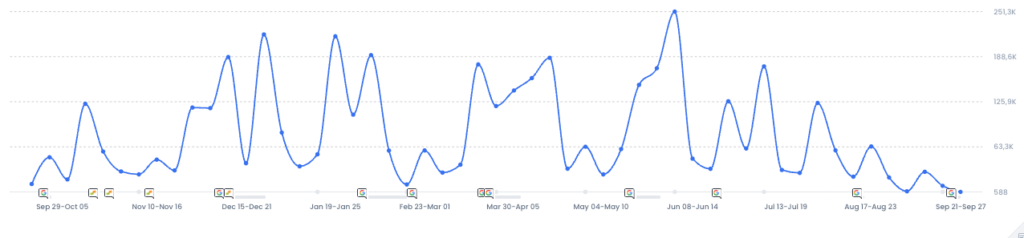
Until early June, The Boston Globe was regularly well-represented in our Discover monitoring. Around June 8, the measured visibility in Marfeel Monitoring peaked at over 251K. After that, a clear decline set in. In the week of September 21 to 27—the exact week the Last Ditch story went viral—the measured value was just 588. Precisely when the Globe published its best-performing story of the year, the publisher was virtually invisible in our Discover data.
Anyone analyzing such a success story expects to see Google Discover mentioned somewhere. On paper, the article had everything: a strong photo, a conflict everyone had an opinion on, and a narrative title that invited further reading. Yet I could not find the article anywhere in our Discover data. That makes the success even more remarkable. While The Boston Globe brought in thousands of new subscribers, the publisher was hardly visible in our monitoring data for Google Discover. In fact, the figures show that The Boston Globe’s measured Discover visibility has declined enormously in recent months.
Until early June, The Boston Globe was regularly well-represented in our Discover monitoring. Around June 8, the measured visibility in Marfeel Monitoring peaked at over 251K. After that, a clear decline set in. In the week of September 21 to 27—the exact week the Last Ditch story went viral—the measured value was just 588. Precisely when the Globe published its best-performing story of the year, the publisher was virtually invisible in our Discover data.
A striking issue on the article page
The first thing I noticed was how the article was displayed in certain situations. Upon opening the page, I saw that in some cases, the comments below the article were pushed upward. This caused key elements, including the title and the featured image, to disappear from view. This problem seemed specific to the Last Ditch article and was observable on both desktop and mobile.
On mobile, Google sees this:

And on desktop, I saw this:

Why do I find this interesting? Google Discover is a personalized feed where users discover articles without actively searching for them. As a publisher, you try to grab attention with a strong image and a compelling title. When someone then decides to click through, they expect to see the corresponding story. If the title and image are missing and the visitor lands directly on a discussion or a paywall, a mismatch occurs between expectation and the actual experience.
My suspicion is that such a user experience can have negative consequences for visitor engagement. Consider, for example, readers who leave almost immediately because they don’t find what they expected. Exactly which individual user signals Google uses for distribution in Discover is not public. Therefore, I cannot determine whether this issue actually influenced visibility. Furthermore, a discrepant display for a visitor is not automatically the same as the rendered page processed by Googlebot. To properly assess that distinction, I would perform additional tests with different devices, browsers, and crawl conditions. From a user perspective, this is certainly a point of concern that I would want to resolve as a publisher.
Is the increasingly aggressive paywall a possible explanation?
During my research, I noticed another development. The way The Boston Globe presents its paywall has changed significantly over the past few months. I used the Wayback Machine to examine historical versions of article pages to investigate how the user experience has evolved.
In April, a visitor without a subscription still saw a relatively modest banner at the bottom of the screen. The most important parts of the article remained visible: the title, author, featured image, and the start of the text. As a reader, you were given an impression of the journalism before being asked to take out a subscription.
In June, the paywall looked like this:

By October, the situation looked very different. The paywall occupied a much more prominent position on the screen and, in some cases, even covered large parts of the title and article text. As a result, visitors hardly had a chance to discover what they were actually supposed to pay for.
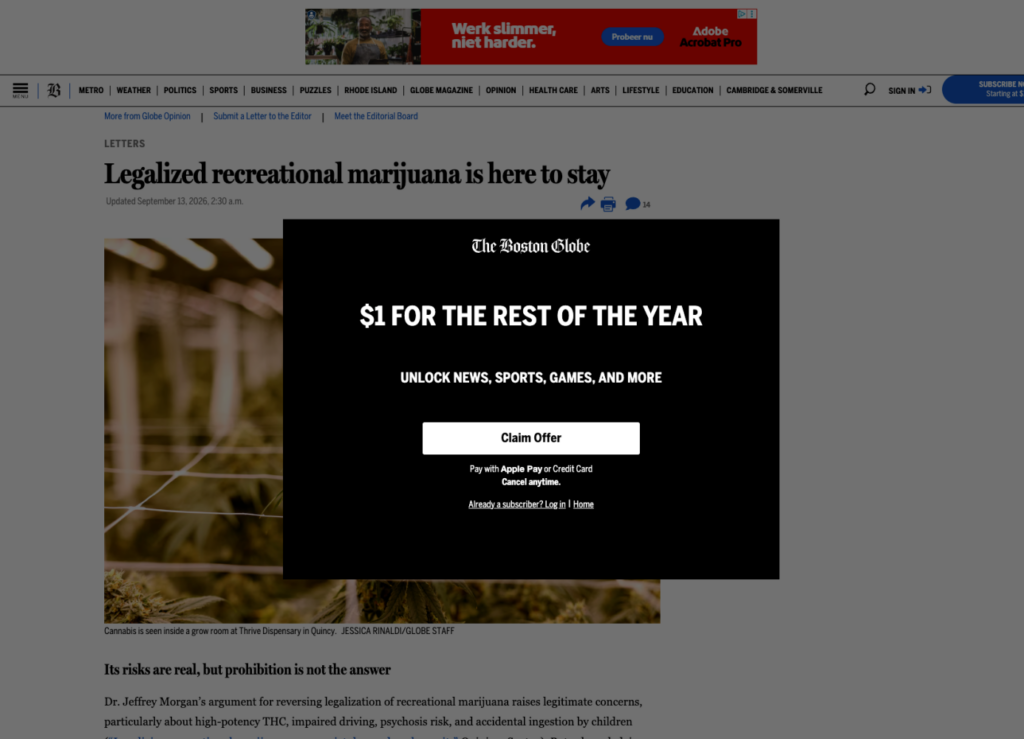
From a conversion perspective, that is an interesting choice. An aggressive paywall can be effective when someone is already convinced of an article’s value. But what happens when someone isn’t convinced at all? That is precisely where I see a potential problem for Google Discover.
Look again at how the Last Ditch story went viral. On X, the article had gathered millions of views. People had seen the photo, followed the discussion, and read others’ reactions. Various public figures and news organizations had weighed in on the subject. Consequently, many visitors likely didn’t arrive without context. They potentially already knew what the article was about, had formed an opinion, and primarily wanted to know exactly what had happened. At such a moment, a $1 subscription can be a relatively small step.
In Google Discover, the starting position is different. There, someone scrolls through a personalized feed and their attention is caught by an image and title. The user may not know the story at all and doesn’t necessarily have the intention to subscribe. When they then click on the article and immediately hit a large paywall, the subscription offer must convince them before the journalism itself has had the chance. That seems much more difficult to me.
I am not saying that a hard paywall cannot work in Google Discover or that Google automatically reduces the visibility of pages with aggressive paywalls. However, I do suspect that the way a paywall is presented can have consequences for the user experience and, potentially, indirect consequences for a publisher’s performance.
What makes this case extra interesting is the timing. The decline in measured Discover visibility began around June. Historical versions of the website show that the paywall changed drastically between April and October. I cannot determine exactly when The Boston Globe switched to the more aggressive variant. Therefore, I cannot prove a causal link between the paywall change and the declining Discover visibility. However, I find it an interesting hypothesis for further investigation.
Technically, much was actually correct
What makes this case even more interesting is that, technically, a great deal is going well. During my research, I observed that The Boston Globe uses max-image-preview:large, an og:image of 1440 × 960 pixels, and extensive social metadata. The NewsArticle structured data is also implemented without validation errors, including markup for paid content. Additionally, the full article text is present in the HTML, meaning crawlers do not rely on executing JavaScript to discover the content.
Still, there are some points for improvement. For instance, article:content_tier is set to free, while the structured data indicates the article is behind a paywall. Also, datePublished signals are not consistent everywhere, and the structured data lacks a reference to the author’s profile page. Furthermore, the News sitemap contains only 100 URLs. The latter isn’t necessarily a problem, as a Google News sitemap should only contain recent articles. To judge if something is actually going wrong here, I would need to investigate how many articles the Globe published during that period and whether they were correctly included in the sitemap.
The technical points of concern are worth improving, but based on my research, I don’t see them as a convincing explanation for the massive drop in measured Discover visibility. My focus, therefore, remains on the user experience, and specifically on how the paywall is presented.
Short-term conversion versus long-term audience growth
If I were to advise The Boston Globe on this matter, I would start by investigating the relationship between the paywall, user behavior, and Discover performance. Specifically, I would want to know if the drop in visibility coincides with the introduction of the more aggressive paywall and if differences are visible between visitors coming from Search, Discover, and social. Subsequently, I would experiment with a paywall where key elements of the article remain visible. Think of the title, featured image, and the first line or paragraph of the story. This way, the journalism gets the chance to convince the reader first.
This doesn’t automatically mean the paywall becomes less effective. It might turn out that more visitors are willing to pay when they first better understand the value they receive in return. I would test that hypothesis based on subscription conversions, user engagement, and the development of Discover visibility. In doing so, I would analyze the results per traffic source, as the intent of visitors from social, Search, and Discover can differ significantly.
What I find perhaps most interesting about this case is the potential tension between maximizing short-term subscription conversions and growing your audience in the long term. From a conversion perspective, the Last Ditch story was exceptionally successful. A single article generated thousands of new subscribers in just a few days. But when you, as a publisher, try to convert increasingly aggressively, you must also ask yourself what that means for the experience of visitors who do not yet know your brand.
Not every visitor is immediately ready to become a subscriber. Some readers need to encounter your journalism several times before becoming convinced of its value. Especially with channels like Google Discover, where users often click through out of curiosity, this seems like an important factor. A hard paywall can ensure that a larger percentage of interested visitors convert immediately, but at the same time, there is a risk that other potential readers drop off before they can build a relationship with the news brand.
This is not just a question about SEO or Google Discover; it touches the entire audience growth strategy of a publisher. What are you ultimately optimizing for? As many subscriptions as possible from the traffic you receive today, or the largest possible group of engaged readers who are willing to pay for your journalism over time? Ideally, these objectives reinforce each other, but that requires looking beyond just the conversion rate of your paywall.
The Boston Globe demonstrates how effective the combination of a viral story and a low-threshold subscription offer can be. At the same time, the massive drop in measured Discover visibility raises questions about how new readers are introduced to the publisher’s journalism. I cannot prove the paywall is responsible for that decline, but it is a hypothesis I would want to investigate seriously as a publisher.
What yields the most subscriptions today isn’t automatically the best strategy for reaching new readers tomorrow. That is precisely why I would not just manage for conversions, but for the full relationship between reach, user experience, engagement, and subscriptions.
Because bringing in thousands of new subscribers is, of course, fantastic. But how many of those people actually remain subscribers once the introductory period is over? That brings me to perhaps the biggest challenge for The Boston Globe: retention.
9. Retention
Thousands of new subscribers within a few days is an exceptional result. Yet, it is likely too early for The Boston Globe to determine how successful the Last Ditch story actually is in the long term. Most new subscribers probably joined due to the massive interest in one specific topic, combined with an introductory offer of just $1. But what happens when the discussion about the bar fades and the introductory period ends?
After that period, the subscription price rises to approximately $30 per month, according to Nieman Lab. That is a significant difference from the original offer. Someone who takes out a subscription for $1 to read one viral article must then find enough reasons to continue paying many times that amount monthly. Nieman Lab identifies this as the key challenge: “to hold on to those subscribers.” How many of the new subscribers actually stay is currently unknown.
This brings us to one of the most important questions for publishers dependent on subscription revenue. Attracting new subscribers is one thing, but retaining them requires a different approach. While the initial conversion may have been driven primarily by curiosity about the Last Ditch story, the value of a long-term subscription must come from the journalism and services that The Boston Globe provides daily. A successful acquisition campaign is therefore only the beginning of the relationship with a new reader.
That is exactly why I find it interesting that the Globe does not exclusively sell the original article in its subscription offer. With the message “Unlock news, sports, games, and more,” the publisher tries to make it clear that a subscription offers access to much more than the story that originally brought someone in. From an audience growth perspective, that is a vital starting point. Someone who subscribes because of one article must then be introduced to other parts of the news brand that align with their interests. Think of relevant newsletters, recurring journalistic features, sports coverage, or other products that ensure readers return regularly.
For publishers, I would therefore look not only at the number of new subscriptions an article generates but also at the quality of those subscriptions over the longer term. How often do these readers return? What other articles do they read? Do they sign up for newsletters? And perhaps most importantly: how many of them are still subscribers after three or six months? By analyzing this data at the article level, you can better understand which journalistic stories not only attract many new subscribers but also contribute to sustainable growth.
I find that distinction important. An article that yields a thousand new subscribers seems more successful at first glance than one that yields a hundred. But if a large portion of that first group leaves after the introductory period, while the second group remains subscribers for years, the commercial value can ultimately turn out very differently. Without insight into retention and the long-term value of subscribers, a publisher is only looking at part of the result.
For The Boston Globe, this information is not public. We know roughly how many new subscriptions the publisher reported, but not how many readers ultimately kept their subscriptions. We also don’t know what onboarding or retention strategy the Globe specifically deployed for this group of new subscribers. It would therefore be too early to conclude that the Last Ditch story is also an exceptional commercial success in the long term.
What this case primarily shows me is how strongly journalism, SEO, distribution, and the subscription model are interconnected. It started with a local story that gained worldwide attention thanks to strong journalism and a universal conflict. The Boston Globe managed to capitalize on that interest and convince thousands of people to subscribe. At the same time, the declining visibility in Google Discover raises questions about the balance between maximizing conversions and continuing to reach new readers.
You cannot plan for a story to go viral, but as a publisher, you can prepare to turn that interest into sustainable audience growth. That requires not only strong journalism and a good distribution strategy but also a subscription model that considers both the initial conversion and the relationship with the reader thereafter.
Ultimately, that is the most important lesson from this case for me. Not the millions of views or even the thousands of new subscriptions determine success on their own, but the extent to which The Boston Globe succeeds in turning incidental interest into a long-term relationship with readers.
Concrete advice for publishers
What can other publishers learn from The Boston Globe’s success? The most important lesson, in my view, is that a viral story does not stand alone. Journalistic quality forms the foundation, but the final value is partly determined by how a story is presented, distributed, and converted into a long-term relationship with readers. Based on this analysis, I would offer publishers the following ten recommendations.
Journalism: invest in stories that spark discussion and engagement
1. Look for local stories with a universal conflict. The Last Ditch story shows that a relatively small local topic can spark worldwide interest when it touches on larger societal issues. Give editorial teams the space to develop these kinds of stories carefully and highlight different perspectives. A journalistically strong story that makes people think provides a good foundation for reach and engagement.
2. Give readers space to engage in conversation on your own platform. Discussions about journalistic stories do not have to take place exclusively on external platforms. With a well-designed and moderated comment environment, you can also engage readers on your own website. Investigate what role this engagement plays in returning visits and subscription conversions, without assuming that more comments automatically lead to better visibility in Google.
Packaging: ensure journalism and SEO reinforce each other
3. Enable editorial teams to optimize titles per channel. Ensure your CMS supports setting the title tag, H1, and og:title separately. This allows you to offer both factual and narrative title variants that align with the different ways readers discover articles. Google ultimately decides which title is shown, but with a good technical setup, you give editorial teams more options to present their stories attractively.
4. Complete the journalistic package before publication. Where possible, invest in original photography that actually tells something about the subject. Additionally, ensure high-quality images at least 1200 pixels wide, correct metadata, structured data, and a highly accessible article page. Also, check the display on mobile devices. When a story unexpectedly goes viral, you don’t want to have to fix key elements after the fact.
Distribution: prepare for unexpected success
5. Create a playbook for stories that perform exceptionally well. Agree in advance on who monitors the performance of key articles and when the editorial team decides to produce additional journalism. Consider a follow-up report, a video, or an update to the original article. Ensure new publications link back to the main article where relevant, so readers can easily find the full context. Journalistic relevance must always remain the guiding principle.
6. Utilize both your own distribution channels and journalists’ networks. Actively share important stories via the channels where the target audience is located and encourage authors to bring their work to the attention of their personal networks as well. Additionally, track which other media and public figures pick up the story. This can offer new opportunities to bring the original journalism to the attention of other target groups.
Conversion: optimize for subscriptions and new readers
7. Make the step to a subscription as simple as possible. A low-threshold introductory offer can be attractive for visitors arriving because of one specific story. Ensure a clear subscription offer, transparent terms, and as few steps as possible in the payment process. In doing so, don’t just sell access to the original article, but show the broader value the subscription provides. Test which combination of price, presentation, and payment options actually yields the best results.
8. Do not optimize your paywall exclusively for conversion. An aggressive paywall may work well for visitors who are already convinced, but it may not align as well with people encountering your journalism for the first time. Therefore, experiment with variants where at least the title, featured image, and a short introduction remain visible. Compare results per traffic source and look not only at subscription conversions but also at user engagement and the development of your reach via Google Discover, among others. What yields the most subscriptions today isn’t automatically the best strategy for reaching new readers tomorrow.
Retention: turn new subscribers into returning readers
9. Offer non-paying visitors a way to stay connected. Not everyone who arrives via a viral article is immediately ready to subscribe. A relevant newsletter can be a low-threshold way to continue the relationship. Ensure visitors can sign up easily and use that opportunity to bring them into contact with your brand’s journalism more often.
10. Measure the long-term value of subscriptions at the article level. Look beyond the number of new subscribers an article generates. Investigate how often these readers return, what other content they consume, and how many of them are still subscribers after three or six months. By connecting acquisition, engagement, and retention, you gain better insight into which journalistic stories actually contribute to sustainable audience growth.
AI Usage Disclaimer: AI was used as a supporting tool for data analysis, structuring information, and improving phrasing during the creation of this analysis. This helped make the research and writing process more efficient. The research direction, interpretations, conclusions, and recommendations are my own.