No more product carousel: what changes for SEO?

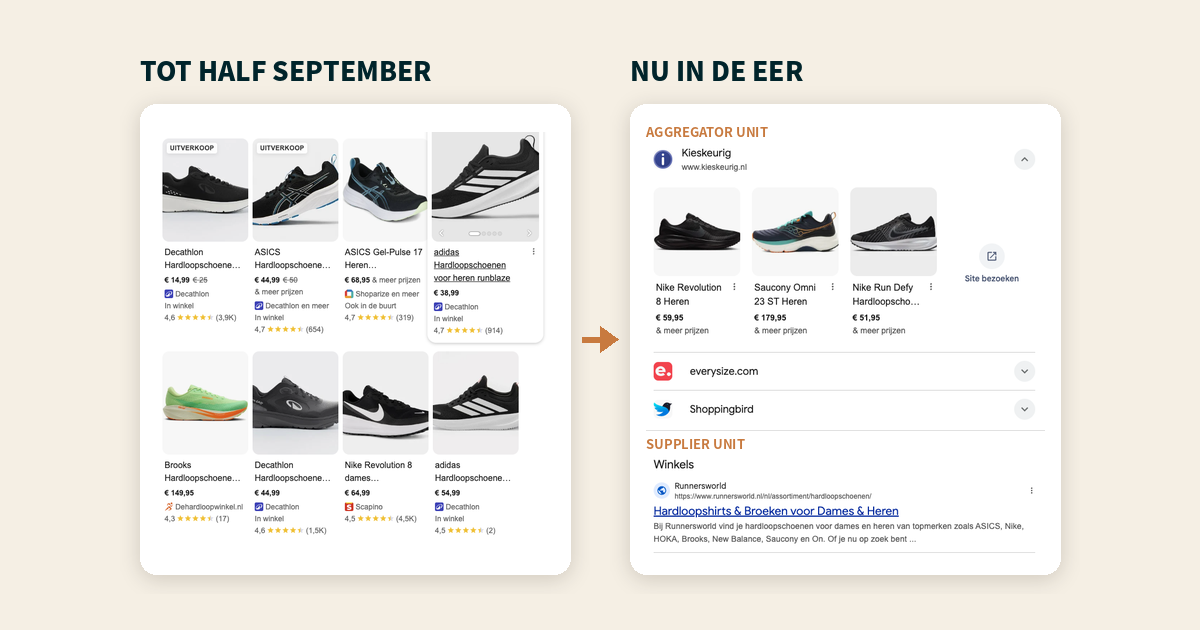
In mid-September, something remarkable happened in the search results. Google removed the free product carousels and product listings from the SERP for the EEA (the EU, Norway, Iceland, and Liechtenstein) as a result of the Digital Markets Act. Google itself calls the adjustments to the European search results the biggest drop in search result quality in its 29-year existence. What exactly happened? And what impact does it have on SEO?
When searching for running shoes, Google used to show its product carousel first—a row of shoes with photos and prices. Those looking for a hotel in Paris immediately saw a map with hotels and nightly rates, and Google also had its own SERP feature at the top for flights. Convenient, but those blocks came from Google itself. Price comparison sites and booking sites, which offer a comparison service, had to make do with a blue link lower in the SERP. According to the European Commission, this is unfair. Under the Digital Markets Act, Google is not allowed to favor its own services. On July 23, Google was fined €460 million for this and given sixty days to resolve it.
This development significantly disrupts organic visibility for products. For SEO, this immediately raises questions. What is the impact of this adjustment? Does optimizing your product feed still make sense for free listings? In this article, I examine what has changed and what you need to adjust in your SEO strategy.
TLDR; key findings.
Wat is er veranderd in de SERP?
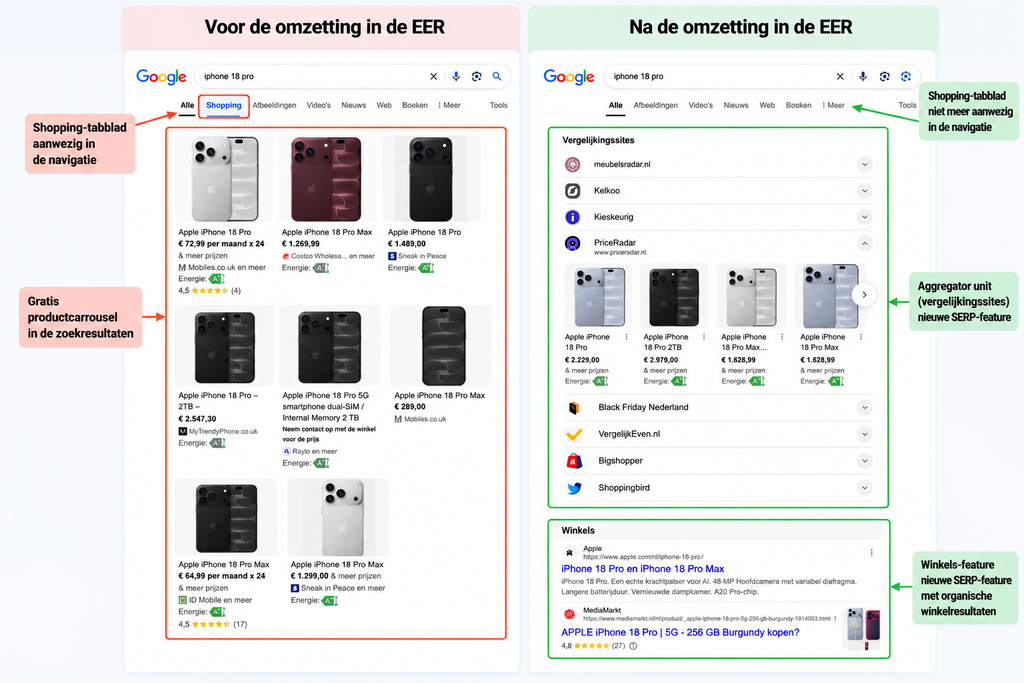
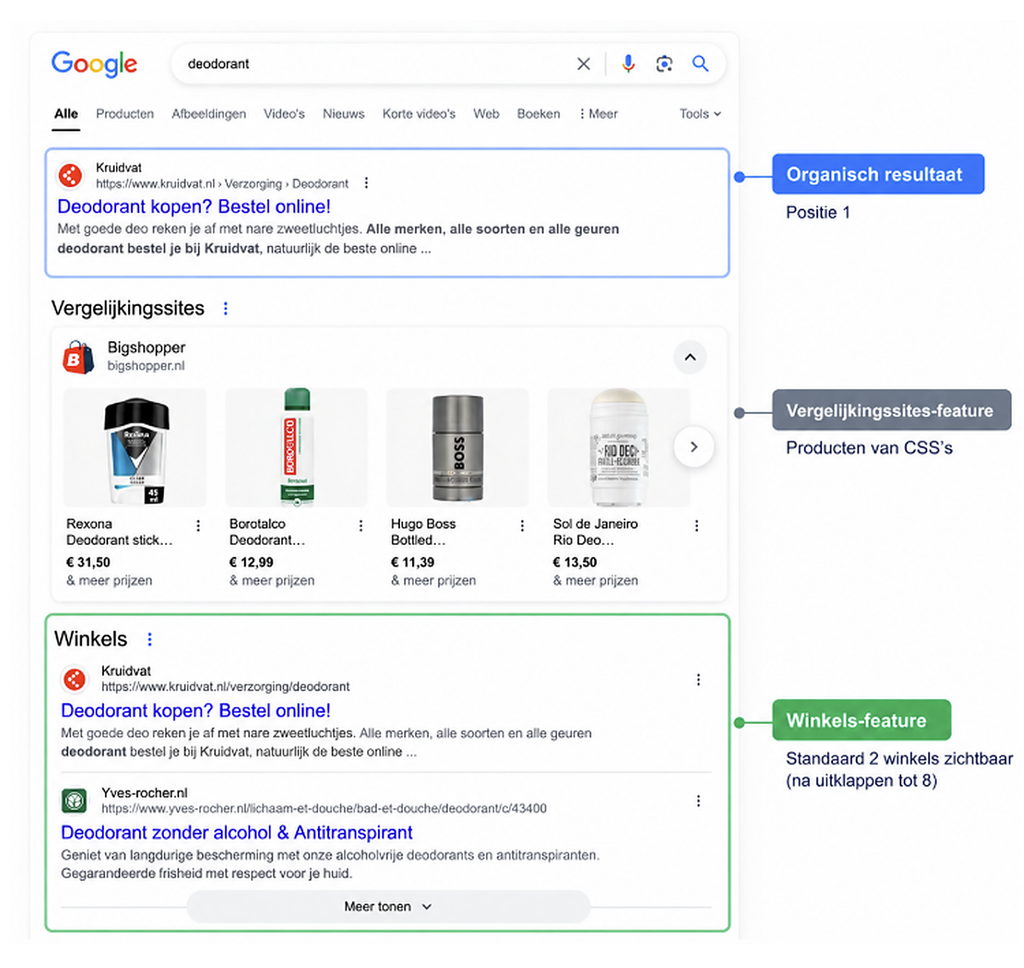
In the EEA, Google added two new blocks to the search results. The “Comparison sites” block, the aggregator unit, is for intermediaries such as price comparison engines and booking sites. One party is expanded showing products and prices, while the rest are listed below and can be expanded manually. Notably, that first party is quite often Google Shopping itself. Below that is the “Shops” block, the supplier unit, for companies that sell the product in question themselves.
De omschakeling ging in stappen:
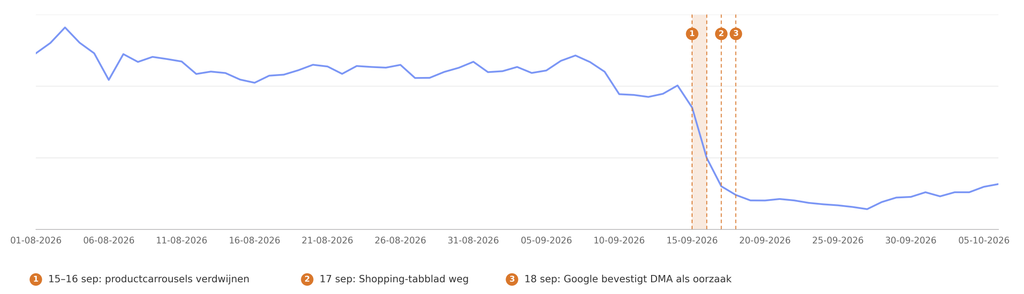
- 15 en 16 september: de productcarrousels verdwijnen in een paar dagen tijd vrijwel volledig.
- 17 september: ook het verdwijnen van het Shopping-tabblad uit de navigatie wordt gesignaleerd.
- 18 september: Google bevestigt dat dit gevolgen zijn van de Digital Markets Act.
Deze wijzigingen hebben dus de nodige impact gehad op onze organische zoekresultaten. Zie hieronder een visuele vergelijking van voor en na de omzetting van Google, bij een zoekopdracht naar een ‘iphone 18 pro’.
Hoe de nieuwe SERP features werken
- Elke vergelijkingssite krijgt een eigen regel. De regels zijn uitklapbaar en de best scorende aanbieder staat standaard open. Wie dat is, bepaalt Google.
- Google Shopping doet mee als een van de vergelijkers. Het heeft een eigen regel in het blok, maar staat niet automatisch bovenaan.
- Bij Google Shopping blijf je binnen Google. De productkaarten tonen een prijs met het label “& meer prijzen”, maar geen winkelnaam. Klik je op een kaart, dan opent Google het oude shopping-overzicht van alle winkels die het product verkopen, met hun prijzen. Pas daarna klik je door naar een webshop.
- Bij andere vergelijkers verlaat je Google direct. Klik je op een product in de regel van bijvoorbeeld Beslist, dan kom je meteen op beslist.nl terecht.
- Winkels is een aanvulling op vergelijkingssites. Je hoeft hiervoor niks aan te leveren, Google haalt de informatie van je website. Maar deze feature verschijnt alleen als er ook vergelijkingssites staan.
In het Verenigd Koninkrijk en de Verenigde Staten zie je de product carrousels gewoon nog. Wie internationaal verkoopt, heeft dus te maken met twee verschillende SERPs als het gaat om free shopping listings voor dezelfde zoekopdracht. Welke features in welk land verschijnen, zet Google op een rij in dit overzicht: Regional differences in Search Experience
Komt het ooit terug in de oude vorm?
Dat is nog niet te zeggen, maar op korte termijn ligt het niet voor de hand. Google heeft niets gezegd over een terugkeer van de gratis listings in Europa. De Europese Commissie houdt in de gaten hoe Google de wijzigingen uitvoert.
Google itself indicated that it is considering an appeal. Such an appeal does not suspend current obligations, so the SERP will likely remain the same regarding product features for the time being. It could go even further. Google has proposed to the European Commission to no longer favor its own services, such as Google Shopping, over comparison sites in AI Overviews and AI Mode. Exactly what that will look like is not yet determined.
Minder klikken voor webshops, meer voor vergelijkingssites
For commercial search queries, organic shopping listings were almost always in view, so many webshops will feel this. How much traffic disappears and where it goes naturally varies per site. Below is an example from one of our clients in Search Console, showing that the number of clicks from merchant listings has decreased by an average of about 75% since the change.
Je kan dit zelf controleren in je Search Console-account door naar Prestaties > Zoekresultaten te gaan en daar een paar filters in te stellen:
- Klik op Filter toevoegen en kies Zoekopmaak. Selecteer ‘verkopersvermeldingen’.
- Analyseer data in landen binnen de EER (zoals Nederland), of nog interessanter: vergelijk de impact binnen de EER en erbuiten als je wereldwijd verkoopt.
- Wil je de precieze impact meten? Vergelijk hetzelfde aantal dagen zowel voor als na 16 september en bekijk de procentuele verschillen in klikken.
Wie profiteren van deze nieuwe SERP?
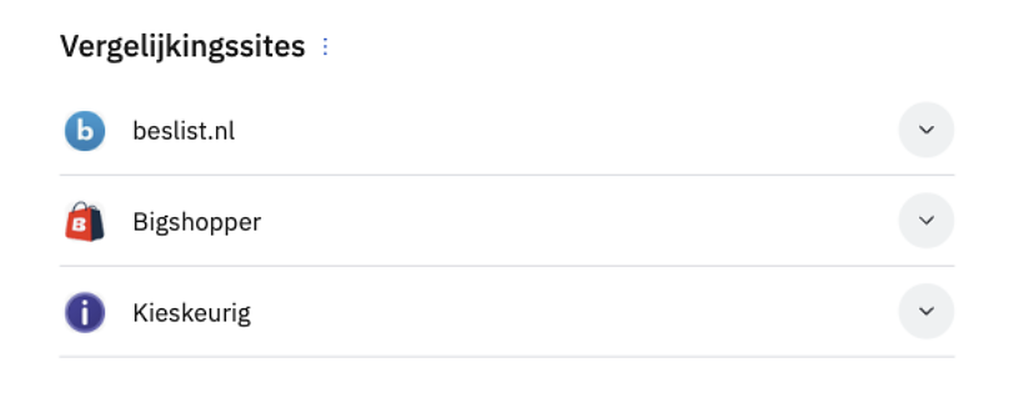
I was curious which comparison sites actually end up in that new block. Therefore, I viewed the results incognito for 30 commercial keywords across various categories: from airfryer and smartwatch to winter coat, box spring, and vitamin D. The Comparison Sites block appeared for 29 out of 30 keywords. Google itself appeared most often, but after that, the same big names often returned for my search queries: Bigshopper, beslist.nl, and kieskeurig.nl.
Voor die drie heb ik in Ahrefs gekeken hoe hun geschatte organische verkeer zich ontwikkelde. Ik vergeleek het gemiddelde verkeer per week in de vier weken vóór de omzetting (10 t/m 31 augustus) met ruim twee weken erna (21 september t/m 5 oktober).
| Domein | Voor (gem./ week) | Na (gem./ week) | Verschil |
| Beslist.nl | 400.801 | 1.264.201 | +215% |
| Bigshopper.nl | 14.740 | 26.857 | +82% |
| Kieskeurig.nl | 75.849 | 99.298 | +31% |
Alle drie groeiden flink. Beslist verdrievoudigde zelfs. En dat is waarschijnlijk nog een onderschatting. Ahrefs baseert zijn schattingen op posities in de gewone zoekresultaten. Het blok Vergelijkingssites registreert Ahrefs wel, maar zonder het aan een site toe te kennen. Bovendien ververst Ahrefs niet alle zoekwoorden even vaak, waardoor een deel van de data nog de situatie van vóór de omzetting laat zien. De daadwerkelijke impact is dus waarschijnlijk nog groter dan Ahrefs op dit moment laat zien. Of de DMA hiermee zijn doel volledig bereikt, is nog maar de vraag. Maar vergelijkingssites lijken er voorlopig in ieder geval flink van te profiteren.
Onderzoek: Samenhang organische posities en supplier unit
Yet it is not only bad news for webshops. Below the Comparison Sites block, as mentioned earlier, is a second SERP feature: Shops, with webshops selling the product themselves. To see how that feature works, I investigated 50 new commercial keywords from various product categories and viewed the search results in an incognito window. The results provide an indicative picture but are naturally not always representative of all types of commercial search queries. The selection of keywords can influence the results, and Google may still adjust the functioning and display of the feature. This is what I saw:
| Onderzoeksvraag | Bevinding |
| Hoe vaak verschijnt de Winkels-feature? | Bij 44 van de 50 zoekwoorden (88%). Het blok Vergelijkingssites verscheen bij 45 van de 50. Winkels verscheen nooit zonder Vergelijkingssites. |
| Hoeveel winkels worden standaard getoond en hoeveel na uitklappen? | Standaard 2. Na uitklappen gemiddeld 7, variërend van 2 tot 10. |
| Hoe vaak komen de eerste twee winkels exact overeen met de organische top 2? | 32 van de 44 keer (73%). |
| Hoe vaak verschijnt de organische nummer 1 in de Winkels-feature? | 38 van de 44 keer (86%). In al die gevallen stond de nummer 1 ook bovenaan in de feature. |
| Welk percentage van de organische top 3 komt voor in de Winkels-feature? | 82% (108 van de 132 posities). |
| Welk percentage van de organische top 5 komt voor in de uitgeklapte feature? | 77% (161 van de 210 posities).* |
| Welk percentage van de organische top 10 komt voor in de uitgeklapte feature? | 75% (193 van de 258 posities).* |
| Hoe vaak wijkt de volgorde van de winkels af van de organische ranking? | Geen enkele keer (0 van de 44). Google slaat soms winkels over of voegt andere winkels onderaan toe, maar behoudt de onderlinge volgorde van de opgenomen organisch rankende winkels. |
*Only regular organic search results were included in the study. Not every search query shows the same number of organic results, and domains that appeared multiple times were counted once per search query. As a result, the number of investigated rankings is lower than 44 times 5 or 44 times 10.
| Organische positie | Vermeld in Winkels-feature | Aantal |
| 1 | 86% | 38 van 44 |
| 2 | 82% | 36 van 44 |
| 3 | 77% | 34 van 44 |
| 4 | 77% | 34 van 44 |
| 5–9* | 62% | 51 van 82 |
*Not every page had 9 regular results. From position 5 onwards, the number of measurements therefore drops quickly, and the percentages are less reliable.
It turns out that the new shops feature is strongly correlated with traditional organic search results. In 73% of the search queries, the first two recommended shops exactly matched the organic top 2. Even more striking is that in all 44 search queries where the shops feature was shown, Google did NOT change the relative order of the organically ranking shops.
De kans om überhaupt in de feature te verschijnen hangt duidelijk samen met je organische positie. Van de organische nummers 1 verscheen 86% in de Winkels-feature, tegenover 77% van de nummers 3 en 4. Bij lagere posities neemt die kans verder af.
Sinds de komst van de winkels-feature levert een hoge organische positie dus vaak een dubbele organische vermelding op de eerste pagina op. Je kunt namelijk zowel in de gewone zoekresultaten als in de winkels-feature staan.
What does this mean for your e-commerce SEO strategy?
These changes in Google require a number of nuances in your SEO strategy. Where you previously could create visibility through free product listings from Google itself, your regular organic rankings and listings on third-party comparison sites now play a larger role. What can you concretely do with a webshop regarding this?
- Investigate your rankings for commercial keywords. Higher organic rankings are strongly correlated with listings in the shops feature. Therefore, look for low-hanging fruit: keywords where you currently score between position 3 and 10, with an interesting ratio between difficulty and search volume, high purchase intent, and a good profit margin or chance of repeat purchases. A spot in the top 2 is particularly interesting, as it offers a high chance of two organic listings on the first page. Additionally, maintaining such achieved rankings is naturally just as relevant, so monitor these intensively.
- Research relevant comparison sites for your offering. See which parties are often included for commercial keywords that align with your webshop’s offering. Check if your products are currently already listed there. Is your assortment missing? Register your webshop with these parties and see if you can provide a product feed. Ensure a feed that allows for good comparison with full product titles, correct GTINs or MPNs, up-to-date prices, and availability.
- Optimize your product feeds, but no longer just for Google… Product feeds remain relevant for organic visibility within Google Shopping, product snippets, and markets outside the EEA. They are also becoming increasingly important for AI shopping, now that ChatGPT Shopping increasingly uses integrated product feeds instead of regular web search. Therefore, preferably choose a direct product feed or platform integration instead of exclusively a structured data crawl. With feed tooling, you can more easily enrich product information with, for example, product highlights and technical specifications. This makes relevant product data more accessible and processable for AI systems, which can use this information to compare and recommend products. Within your SEO strategy for the EEA, I would give feed optimization for Google a lower priority for now than regular rankings and visibility on comparison sites.
- Follow developments regarding the new SERP features. Google may still adjust the current configuration of the new SERP Features or find new ways to comply with regulations. Therefore, keep an eye on the latest news and regularly check what the search results look like for your commercial keywords. Inquire with your SEO agency about the possibilities for monitoring your visibility within these new SERP features, or keep an eye on developments within SEO tooling yourself.
- Give category pages more priority. Now that the free product carousels have disappeared, regular organic rankings for broad commercial keywords such as ‘deodorant’ and ‘running shoes’ can be extra valuable. Analyze which keywords you currently rank for only with product pages or are not visible at all, while competitors rank at the top with category pages. Investigate whether you can improve existing category pages or create new ones for this purpose.
The free product carousels may have disappeared, but plenty of opportunities for organic visibility of products remain. The challenge lies primarily in targeted adjustment of your SEO strategy to the new search results and cleverly capitalizing on the extra visibility that the new SERP features can offer for your assortment.